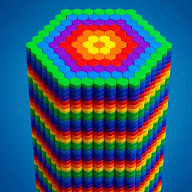
Stack hexagon tiles by colour until they merge and clear
 14:36
14:36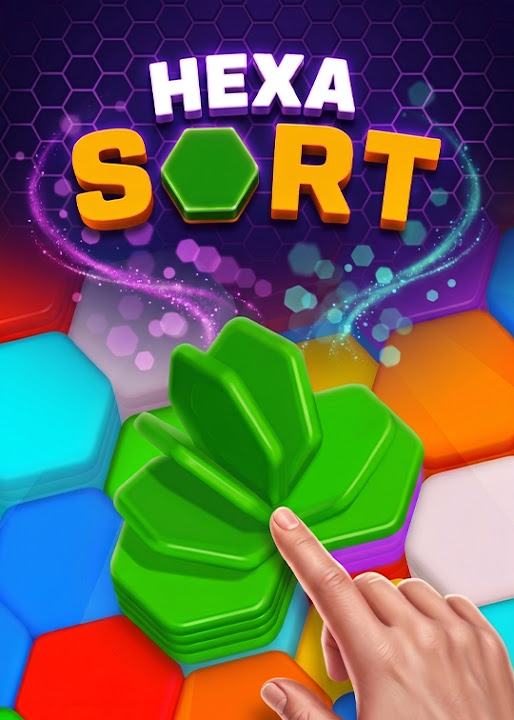
TubeGames verdict
A slow sorting puzzle that clicks when you realize the stacks are layered, and stalls when the board fills.
Reviewed by Max, TubeGames · Sep 18, 2026 · How we rate
Hexa Sort hands you stacks of colored hexagon tiles and a small board, and asks you to put like next to like. When enough of one color touches, the tiles slide onto one pile and clear. The first few placements felt like nothing was happening; then two stacks flowed together with that soft click and I understood what I was building toward.
The trick is that stacks are layered. The color on top isn't the whole story, and a good placement sets up a second merge once the top layer clears. So you start reading stacks like cores, planning two moves ahead, and the board's few open spaces become the resource you're really managing. Levels give you collection goals, boosters show up when things get tight, and the pace is entirely yours.
Complaints: it's slow by design, and if you want feedback every second this will feel like watching paint sort itself. The later boards get cramped fast, and I lost a couple of them because the game dealt me colors that had nowhere to go. The boosters get offered a lot when you're stuck.
Play it if you like quiet, spatial puzzles you can leave and come back to. Skip it if you need speed or a score that climbs in real time.
Good
- Layered stacks make placements matter two moves out
- No timer, no pressure, play at your own pace
- Merges feel and sound good
- Plays inside YouTube, no install
Not so good
- Late boards fill up fast and can feel unfair
- Slow by design; not for anyone who wants speed
- Boosters get pushed when you're stuck
About Hexa Sort
A relaxing brain puzzle game where you sort hexagon tiles by color and merge them together.
Hexa Sort was published on YouTube Playables on 2026-08-04 by Play Land. In 67 days it has reached about 89K plays.
Hexa Sort asks you to place stacks of coloured hexagons on a board so that like colours end up together. When enough of one colour meets, the stack merges and clears space for whatever comes next.
Nothing is pushing you along, so it works as a slow puzzle you think through at your own pace, and a bad placement costs room rather than a run. It plays free inside YouTube with no download, which suits it for short breaks.
How to play: Drag each stack onto the board and group matching colours to merge them.
Good for: relaxed puzzles, short breaks
How to play Hexa Sort
- Phone / tablet
- Drag a stack from the tray onto an empty hex on the board; matching colors that touch merge on their own.
- Desktop
- Click and drag a stack with the mouse onto an empty space; the game handles the merging.
- Levels
- Level-based, each with a collection goal to hit before the board fills.
The color on top of a stack is what merges, but the layers underneath decide what the space is worth once the top clears.
Tips for the crowded boards
- Read the whole stack, not the top. Before placing, look at the lower layers. A stack with red on top and blue underneath belongs near blue, because the red will leave.
- Keep one hex empty at all times. The board is tiny and a full board is a lost level. Treat the last open space as untouchable until a merge is guaranteed to free another.
- Build one big pile, not several. Merges clear when a pile gets tall enough, and a single tall pile gets there faster than three short ones scattered around the board.
- Place mixed stacks between their colors. A two-color stack on a hex that touches both colors will merge twice. That's the move that unclogs a board.
- Don't buy your way out early. The boosters are there for the last few moves of a bad level, not the first few levels. Learn the layering first and you'll need them far less.
Hexa Sort vs Water Sort and the other sorting puzzles
If you've played Water Sort or Ball Sort, you know the rhythm: move one thing, uncover what's underneath, plan around it. Hexa Sort takes that and puts it on a board instead of in tubes, so position matters as much as order. That's the big difference. In Water Sort a wrong pour costs you a move; here a wrong placement costs you a space, and spaces are what you run out of. It's also more forgiving in one way, since merges happen automatically when colors touch and there's no timer. I find it calmer than Water Sort and harder to master.
Hexa Sort promo codes and cheats
People look for Hexa Sort promo codes and content creator codes. Those belong to the mobile app's shop, and nothing like that exists inside the YouTube version; there's no code box to type into. The same goes for cheats. What actually helps is slower: read the lower layers of every stack, keep a space open, and use the boosters only when a level is otherwise lost. That got me through boards I'd have called impossible on the first look. If you want the app's codes, the app is where to look; here the game is just the game.
How plays are counted
Public play counts for Hexa Sort are re-counted every day from the YouTube Playables catalog and shown the way YouTube shows them. The total and rankings above are as of 2026-10-10.
Ratings & reviews
No written reviews yet — tap the stars and tell other players what you think.
Elsewhere: 4.7★ (218,685 ratings) on App Store · 8.6/10 (4,233 votes) on CrazyGames
How we rate
The TubeGames rating is our estimate, not a vote. It combines public ratings of the same game elsewhere (App Store 4.7★ (218,685 ratings), CrazyGames 8.6/10 (4,233 votes)) with how it holds up on YouTube Playables: how many people play it and whether they keep playing weeks after launch. Once 10 players rate Hexa Sort here, their average becomes the headline score.
Similar Brain & Puzzle games on Playables
 Thief Puzzle
91M plays
 Save The Pets
38M plays
 Skincare Time: Makeover ASMR
64M plays
 DOP 4: Draw One Part
41M plays
 Emoji Puzzle
39M plays
 DOP 2: Delete One Part
35M plays